In the morning, we visited the Santa Rita Winery in the Alto Jahuel in the Maipo Valley. Santa Rita was founded in 1880, and was owned for many years by one of Chile’s most famous poets, Vicente Hidobro Fernandes. They pioneered the planting of Bordeaux varietals and are now considered one of the best wineries in Chile. We were familiar with their wines and were looking forward to the tour.
 |
Roses are planted at the end of each row of vines
to try to control aphids. |
What a treat when we arrived at the winery to find the Museum of the Andes (Museo Andino). The museum houses a stunning private collection of indigenous art and culture of Chile. It was collected by businessman, Ricardo Claro, over a period of 40 years. The collection was beautifully display and described, and we would have loved to have more time to learn about it. I took a few photos of the pre-Columbian collection before being asked by the security guard not to take photos.
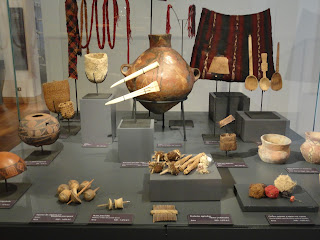 |
| Pre-Columbian pieces |
In another area, there was an impressive collection of artefacts relating to the huasos, the Chilean horsemen. Lloyd was so impressed with it that we tried to buy a book about the collection; since none were available, they suggested we just take photos, so we did! I did not push my luck in taking photos of the room of Incan gold items, though.
The rural equestrian art of Chile has its origins in both Spanish and Malpuche Indian cultures. The dress of the huaso, the man of the countryside, reflects the blending of these two cultures.
 |
The rowels on these spurs were 4-5 inches (12 cm) wide.
The rider would place them beside, rather than 'into' the side of the horse. |
 |
| I liked the rawhide liners in these spurs. |
 |
| Metal stirrups |
 |
A metal headstall;
reins would be attached to the dangling metal triangles. |
 |
| Wooden stirrups |
 |
| The huasos we saw the next day were using stirrups of this shape. |
 |
| Spanish silver was converted to beautiful Mapuche jewellery. |
 |
| A huaso belt, decorated with silver |
 |
The huaso wore a short poncho calleda 'chamanto' or 'manto'.
This piece was once a family treasure in Teresa's family.
Unfortunately, I missed much of the story, busy taking photos.
These photos do not do the chamanto justice because of the gallery lighting. |
 |
The chamanto is usually reversible
and may take up to six months to make.
When not worn for warmth, they are folded and worn over the shoulder. |
Lunch was at La Casa de Dona Paula Restaurant, a National Monument, named after Ms. Paula Jaraquemada, the former manor owner of the Santa Rita estate over 200 years ago. The grounds were serene and lovely, with a cool porch for several wine tastings before lunch. Our tasting continued with two reds during lunch.
 |
| wine in the shade before lunch |
One of the famous Santa Rita wines is the 120 brand, created in honor of 120 soldiers who served under General Bernardo O’Higgins. The patriots were hidden in the manor cellar after a fierce fight against Spanish Crown soldiers. We have enjoyed ‘several’ bottles of Santa Rita 120 since returning home – a lovely, light white wine that has become a favorite of mine. Lloyd’s favorite is the Santa Rita Santa Rita Reserva Cabernet Sauvignon. Also very nice.
After lunch we headed to the Concha y Toro winery, to be covered in the next post.