Monday, April 2, 2012
The last day of our tour began with an entertaining bus trip to the estancia. Our local guide dressed in Malpuche Indian garb to tell us about the history and culture of this strong and resourceful people who once occupied much of the vast ‘cone’ of South America.
 |
This was the first of 2 outfits.
Given that we were on a bus, we were impressed! |
The Malpuche were never defeated by the Spanish and successfully incorporated elements of the Spanish culture into their own lifestyle. They are the third largest indigenous population in South America. We were again impressed by how well-informed our guide was. We even got a brief demonstration of traditional Malpuche music, with our marine historian, Revell Carr, trying to produce a sound from the horn – with limited success!
 |
| Note the beautiful Malpuche silver earrings. |
 Upon our arrival at El Pregon, we were met by a mounted rider who led our bus down a shaded lane. There, he was joined by other huasos, who welcomed us to the venue. El Pregon is a showplace rather than a working estancia. It is the site of weddings almost every weekend, as well as corporate and ‘touristic’ events. This was the only day we sat in the first seats in the bus, so I was lucky with the photos.
Of course, Lloyd was interested in the tack, and took a close look at the headstall, bit and reins. He would have traded his hat, but all the huasos had smaller heads!
 |
The saddles have lots of padding and no horns -
more about that later. . . |
We were greeted by the owner of El Pregon, who, with his wife, had purchased the property a few years ago, fulfilling a longtime dream. He is wearing typical huaso clothing, with a short, fitted jacket, slim pants, the flat-crowned Cordoban hat, and chamanto folded over his shoulder.
 |
You can see that the chamanto,
a treasured possession, is reversible |
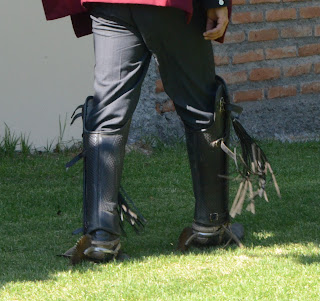
The riders wore stripped mantos - more of a working man's style - rather than the beautifully woven chamanto of the owner. They also wore leather leggings and ankle-length boots with the big spurs.
We were shown to a circular arena where the huasos showed off their horsemanship, doing a smaller Chilean version of the RCMP musical ride, demonstrating the difficult sidestepping, and ‘dancing’ on horseback.
The senora then showed off her fancy Peruvian gaited horse.
 |
She was very elegant, with a shawl-type shirt over her jeans,
and another around her shoulders. |
 |
| Note the bell-shaped stirrups |
If you are interested in more information about the Chilean horse and the attire of the huaso, there is an excellent website - http://www.chileanhorse.com. It also includes information about the Chilean rodeo (under the SPORT heading in the list on the left of the website), which is quite different from the North American version. "The Chilean Rodeo is a paired team event whereby the members of the team have to take turns between driving and pinning positions. The objective of the sport is to show control in driving a steer to a given section on the half-moon arena (called “medialuna” in Spanish) wall where some part of the side of the bovine’s anatomy is pushed by the chest of the pinning horse until the steer is pinned to a standstill on the padded cushion that defines the Pinning Zone." The website includes a video (click on the blue word and press the arrow to play the video) that shows how the huaso guides the horse's chest to make contact with the cow (not a calf). Teresa explained to us that there are more points for pinning the cow's hip (4 pts) rather than the shoulder (1pt). She also explained that the horse's chest hits the cow firmly, and that the rider could be 'damaged' if there was a horn on the saddle. We then moved to a beautiful park like area of the property, where we were served several hors d’oerves while we enjoyed music and the dancing. The gardens were gorgeous, and it was hard to select which photos to share.
 |
| The park-like setting included several pools and seating areas. |
 |
| El Pregon was quite a contrast to the cactus-covered hills. |
 |
| Appetizers by the pool |
For lunch, we moved onto a patio covered by a large white awning. We were served empanadas, and then a beautiful filet of beef, which most of us could not finish after all the appetizers!
The entertainment continued after lunch, with the senora surprising the young dancers by joining in their dance. From the surprised looks on their faces, this was not a usual occurrence, but they relaxed and had fun.
The senora also sang for us – beautifully. We should have bought her CD.
After lunch we had about an hour to relax in a hammock, go for a stroll, or watch the senora try out a new Peruvian horse as her husband looked on.
We returned to the patio to find that George had borrowed the guitar, and he and Carolyn led an impromptu singalong of old favorites.
After posing for a group photo, we enjoyed a final farewell serenade, and boarded the bus for the airport.
 |
| Road Scholars, Around the Horn 2012 |
Our local guide was very helpful, making sure that we all got our boarding passes before she left the airport – typical of the attentiveness of our hosts throughout the trip.
Our flight back to Dallas was much more pleasant than the initial flight – efficient boarding, pleasant staff, and a less crowded flight. We were lucky to get out of Dallas about an hour before the tornados struck; otherwise we would have been stuck there for a couple of days, I think, with more than 200 American Airlines (and affiliates) planes damaged.
Although I had hoped to do this blog while we were travelling, it was good to have time to remember and reflect as I posted the various stories. It was a wonderful trip – quite an adventure, full of learning and laughter, great people, new friends, beautiful sights, and great meals, and Lloyd loved it. Who could ask for more?