Sunday, 15 April 2012

On Board the ms Veendam


Day 3: Boarding the ms Veendam

Traffic in Buenos Aires

We had a leisurely morning in Buenos Aires, and went for a short walk around several blocks adjacent to our hotel before boarding the bus which took us to the pier.

The port of Buenos Aires is a huge commercial shipping area and it was fascinating to watch the big cranes move the containers around.


This photo shows the Costa ship in the background. It seemed to attract more families, and, after Montevideo, we did not see it again, so it probably headed north to Rio. We were congratulating ourselves that we were on Holland America, and laughed later when we found out that both cruise lines are owned by Carnival!
We boarded the ship, and spent the rest of the afternoon unpacking and getting to know our way around the ship.

A 'cutaway' view of the ms Veendam
The Veendam is one of Holland America’s smaller ships, with capacity for only 1200 guests.  We were on the lower promenade deck (Level 6), which made it easy to access the outdoors for photos.  Decks 4-12 were accessible to guests, and included a large two-level showroom, a smaller theatre, meeting rooms, numerous lounges (each of which provided different musical entertainment in the evening), a library, shops, a casino, spa and gym, a smallish pool and several hot tubs.
Food was available in one large restaurant, open all day, and several other options, as well as the formal two-level dining room. Our group was booked for the early seating at 5:45. As we had a number of tables, we had the opportunity to dine with all of the members of our group over the 12-day trip.

Our tables were located on the upper level.
Note the netting under the lighting. We wondered if it was there
 to catch any glass that broke in high seas.
The service throughout the trip was excellent, with almost 600 staff. We enjoyed the different animals, made of folded towels, that greeted us each night. The meals were very good, with little waiting in line at the Lido. The gourmet meals in the dining room were amazing, with four courses each night – two appetizers, an entree and a dessert. It was often hard to choose between the selections. Everything was excellent – prime rib, tenderloin, seafood, duck, great soups, both hot and cold (a favorite of mine was a cold pear soup!) – and the portions were ‘right-sized’, so that we felt satisfied without feeling ‘stuffed’.
Caroline and George, from Oregon, and Julia, from California


Barb and Lloyd with Betsy, from California
Evening meals provided great opportunities for extended conversations with our travel companions. Lots of interesting stories, and always laugher.

The Music and Dance of Santa Susana

I have posted the following short videos there for those of you who are interested:
  • The Music of Santa Susana
  • Santa Susana Tango
  • Traditional Argentinian Dance
  • Dance of ‘las boleadoras’
They all performed with such energy. It was fun to see them again. I was lucky to be seated close to the stage, and unlucky to be looking into the bright sunshine through an open door, but that's the joy of casual photography! I was not using a tripod, so hesitated to zoom in and out - thus the missing 'top of the head' when the performers moved to the front of the stage.

     The Music of Santa Susana


    Santa Susana Tango

     Traditional Argentinian Dance


     Dance of ‘las boleadoras’


Saturday, 14 April 2012

The Gauchos of Santa Susana


The gauchos demonstrated a competition similar to the precision lancing exercises we had seen by mounted troops. Small metal rings were attached to leather strips that were suspended from a crossbar.


The rider rode at a gallop, holding a small metal 'skewer' that had ridges cut into it like a screw. The idea was to pick off the metal ring with the skewer - not an easy task.


Success!

The younger gauchos stood tall in the stirrups.


The successful gauchos rode over the the audience, and gave the ring to a woman, hoping for a kiss in return. At the end of the show, the young and pretty were given rides behind the gauchos.


A great day in the sun, and a lovely dinner in a small restaurant back in Buenos Aires, opened just for us.

Thursday, 12 April 2012

Day 2: The Estancia, near Buenos Aires

Excursion to Estancia Santa Susana 


We drove into the ‘pampas’, flatlands or plains, on our second day in Buenos Aires to visit a traditional Argentinian ranch or ‘Estancia’ for a ‘Gaucho Party’. We were greeted by several ‘gauchos’ or cowboys, who were pleased to give each of the ladies a kiss in welcome. The gauchos wore leather belts with rows of silver coins. Apparently the tradition began when they were paid in coins, but had nowhere to spend them. Quite striking!


Betsy gets a welcoming kiss from a gaucho.
Those who wished were then invited to mount up for a brief horseback ride, while others chose the security of the wagons.
Soft lightweight saddles

You can see the pampas stretching to the horizon
behind the gaucho and his dog.


Lots of smiles from Bill, although he said
he found his first ever ride 'terrifying'.
Good for you, Bill!
The old pay window, which now serves as a bar.

We had a little time to relax on the lovely grounds before heading indoors for a wonderful lunch of salads, breads, and barbecued meats – sausages, beef, ribs, chicken – it just kept coming, with little jam pies for dessert. The gauchos also served as waiters.
Long tables of visitors, many from Latin America

Some of our happy group. By the way, the green bottles are water bottles,
though we also enjoyed wine, wherever we were.

After dessert, the music and dances began. First, a singer who played the accordion, accompanied by a guitar, then a dance pair who performed both tango and more traditional or folk dance. They were excellent.


A beautiful  bandoneón, based on the German concertina


The highlight was the dancer who danced with ‘las boleadoras’ or bolos, that were originally used as a weapon against the ostrich and Pampas Indians. He was amazing! We saw a younger, more modern group of both male and female dancers perform on board the ship, but liked this traditional performance much better. I will try to post a video, or a connection to the video in my next blog.


At the end of the show, many of the audience got up and danced. The group from Costa Rica were the most enthusiastic, but George and Carolyn from our group joined in right away. I got to dance with one the gauchos. Fun! A great day.
George and Carolyn

George and Jeannie

Doesn't his look like fun?
In my next segment, I will show you the game of 'ring lancing' which was demonstrated by the gauchos.

Buenos Aires Street Performers


Hope you enjoy this short video. Our friend, George, is the one in the red shirt.

Tuesday, 10 April 2012

The City of Buenos Aires


Day 1:  Saturday, March 17


Skylines and freeways
What a beautiful city! We were picked up at the airport along with about half of our group and taken to our hotel for a short rest and lunch before heading out with the entire group on a tour of the city’s major neighborhoods and attractions. Central Buenos Aires features a beautiful boulevard or parkway with one-way traffic on each side – four or five lanes going each way. The first impression is of a fresh, clean, vibrant city, quite European in flavor, with lovely old buildings with balconied windows.

One of the tall office buildings, the government department of social services  had two huge outline drawings of Eva Peron, one on each side. I was able to photograph one of them. She is very highly regarded. 
Evita's building

We stopped at the Main Square “Plaza d Mayo” which is surrounded by a number of historic buildings: the “Casa Rosada” or the  Pink House”, which is the Presidential Headquarters Office, and the balcony from which Eva Peron made her famous speeches. Other beautiful structures included the “Cabildo”, the Colonial Town Hall, and the Cathedral. It was a gorgeous afternoon, and lots of people were out enjoying the sun and the sights.

Feeding the pigeons

Evita's 'Pink House'
The 'Calbildo' - the colonial town hall built by the Spaniards

An alcove in the church
Our new friend, George, jams with a Dixieland Band in Recoleta Park

We returned to the San Telmo area in the evening for tango lessons at El Viejo Almacen ,  known as the most traditional ‘tango palace’ of Buenos Aires. El Viejo Almacen (the old grocery store) was once the location of the British Hospital of Buenos Aires in the 1840s. It opened as a traditional Tango House in 1969. Our tango instructors were pair of dancers who performed later that night, and they were excellent. We learned the basic set of eight steps, a variation, and a finale, in which the woman places her knee on the outside thigh of her partner.  Lots of laughter, and a great way to start to get to the other members of our group of 24.

After our lesson, we went across the street for a lovely meal (the first of many!) and then returned to the ‘tango palace’ for a two hour show. Most of us thought we would never make it to midnight, but it was very engaging, and no one fell asleep. Four dance pairs performed variations of the tango, in single pairs or as larger groups. They were very talented and polished, and all of them were very sensuous in both their dress and their movements. The band consisted of a piano, two accordions, a violin and a bass, and they too performed with lots of passion. We loved the group of Indian musicians who sang and played traditional music – pan flute, flute, guitar, etc.  We were told how lucky we were to also hear an 85 year-old woman who was once an actress as well, I believe. She had a low, sensuous voice, and was really very good.


We were asked not to take photos of the performance. The tango dances covered several different time periods. All were excellent.This was the best video of the tango dancers at El Almacen that I could find on Youtube. http://www.youtube.com/watch?v=tO2emdst2Ls 

Day 1: continued

I had a few challenges - now solved, thus the Part 1 and Part 2.
I'll remember the trick of doing this.

 
We drove through a few scenic areas, stopping at La Boca, an old area of the city that has become home to artists’ studios. It was originally settled by immigrants who made their homes out of cast off corrugatedmetal which was brightly painted. It is now maintained as an historic area, and we enjoyed walking through the cobblestone streets, admiring the lively artwork and the other ‘touristic’ sights.

'Evita' waves from a balcony

Lovely little multimedia pictures

The Tango


You could pay to have your photo taken with this street tango dancer - props provided.


Soccer fans

 More city views:
A study in contrasts

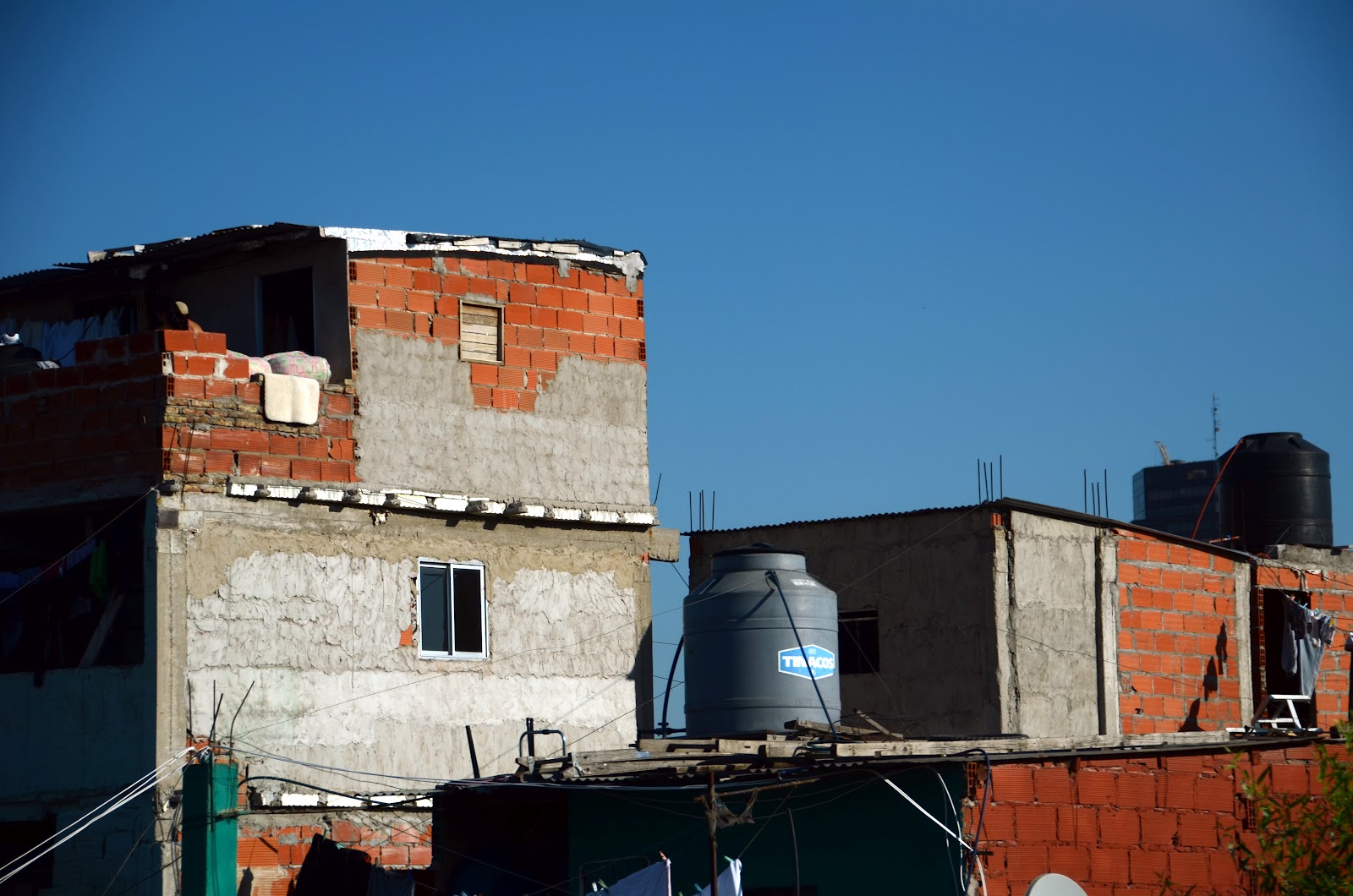
The 'make-do' housing of poor families who have moved to the city

Homes are constructed of whatever materials they can find.
Even here, there are plants in pots.
 From there, we drove through a lovely old and elegant residential area called Barrio Norte, and on to the Recoleta Cemetary, a huge and stunning aboveground cemetery lined with massive and beautifully decorated mausoleums and statues. Our tour ended with a drive though the area known as Palermo. This area had huge mansions, but what we remember is the extensive parks designed by a French architect, and the many sculptures.
Saturday visitors to La Recoleta

The old beauty of La Recoleta

A source of family pride

The walkways of La Recoleta - you could easily get lost in the blocks and blocks and blocks. . .


Family mausoleum of Evita Duarte Peron

The traditional and the modern


As you can tell, this was a very special place.